What You Pay
We don't post a flat number for Pine because the job price depends on what's actually on the door - torsion versus extension, single spring versus a matched pair, and whether the drums or cables need attention at the same time. A door installed near the 1984 median for this area often still runs original hardware, which changes the parts list versus a door put up in the late 1990s.
What we can tell you: the quote is for parts and labor on the spring system itself, not a package deal that bundles in services you didn't ask for. If the spring failure has already stressed the opener - burned out a gear, stripped a chain - that gets called out separately so you know what's spring and what's opener before we start.
The Symptom
The door won't budge, or it slams down instead of lowering, or the opener strains and reverses partway up - these are spring symptoms, not opener symptoms, even though the opener usually gets blamed first. With Pine's housing running mostly 1979 to 2000 and centered on 1984, a lot of these doors have put in three to four decades of winding cycles on the original spring, sometimes the original cable too.
Cold matters here. In a moderate-cold climate band, steel spring wire stiffens and becomes more brittle at the low end of winter temperatures, and a spring already near the end of its cycle count is more likely to snap on a cold morning than a warm afternoon. If you hear a loud bang from the garage overnight in winter, that's almost always the spring letting go, not the door itself failing.
The Complications
Extension springs on older tracks sometimes lack a safety cable running through the coil - required on new installs, often missing on doors from the early 1980s. If we find that on a Pine job, we'll flag it, because a spring failure without a containment cable can send the spring across the garage.
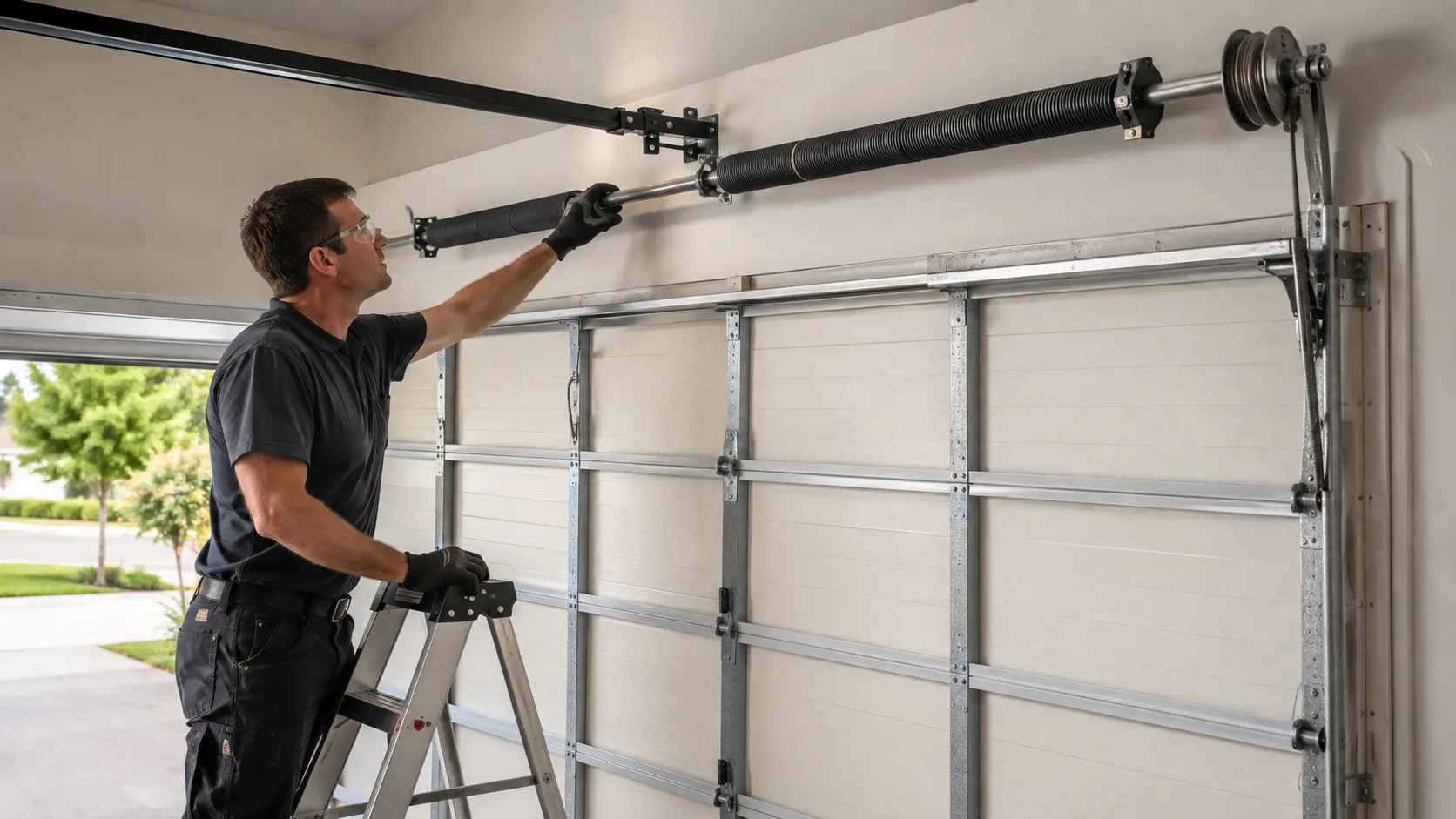
Another complication we see on doors from this era: mismatched springs, where a previous repair replaced one side of a torsion pair but not the other. Two springs of different age and tension on the same shaft wear unevenly and tend to fail again within a year or two, which is a callback nobody wants. With roughly a thousand households in this immediate area and a housing stock that clusters tightly around 1984, this mismatch pattern shows up often enough that we check both springs' date stamps as a matter of course, not just the one that failed.